
Can Custom Contacts Help With Halos and Glare After Eye Surgery?
Halos, glare, and starbursts are common visual complaints after eye surgery. Many patients notice these symptoms most at night, while driving, or in low-light environments. Even when vision tests show good results, visual quality may still feel compromised.
Fortunately, custom contact lenses can often improve clarity and reduce these unwanted visual disturbances — especially when glasses are not effective.
- Why Halos and Glare Occur After Eye Surgery
Visual disturbances after surgery are usually caused by subtle irregularities on the eye’s optical surface. These may result from:
- LASIK or PRK healing patterns
- Cataract surgery with multifocal or toric implants
- Corneal scarring or uneven reshaping
- Post-surgical higher-order aberrations
These changes scatter light as it enters the eye, leading to glare, halos around lights, and ghosted images — symptoms glasses often cannot fully correct.
- Why Glasses Often Fall Short
Standard glasses correct basic refractive errors but cannot neutralize complex distortions caused by an irregular cornea. As a result, patients may still experience night vision problems despite “20/20” results on an eye chart.
This is where custom contact lens designs offer a significant advantage.

- How Custom Contact Lenses Improve Visual Quality
Custom lenses are designed specifically for the unique shape and optical behavior of each eye. Instead of sitting on the tear film alone, these lenses create a smoother optical surface, allowing light to enter the eye more evenly.
Among advanced options, scleral lenses are often recommended for patients with post-surgical visual disturbances. They vault over the cornea entirely and maintain a fluid layer that neutralizes surface irregularities, significantly improving clarity and contrast.
- Advanced Technology Behind Custom Lens Fitting
To determine the most effective lens design, specialists rely on detailed diagnostics, including:
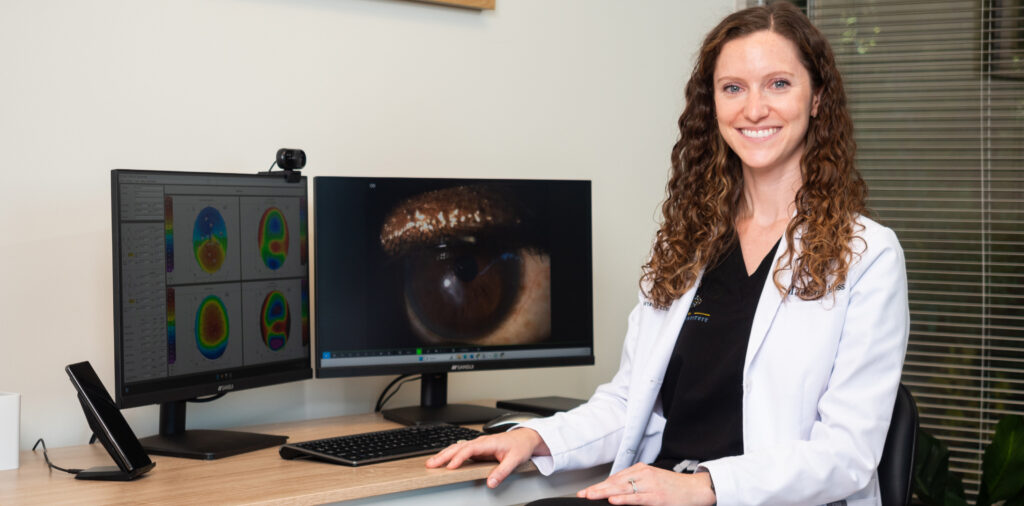
- Corneal topography to map surface irregularities
- Wave front analysis to measure higher-order aberrations
- Anterior segment imaging to evaluate lens clearance and alignment
This precision ensures that the lens addresses the root cause of glare rather than masking symptoms.

- Who May Benefit From Custom Contacts After Surgery
Custom lenses may help patients who experience halos or glare after:
- LASIK or PRK
- Cataract surgery
- Corneal transplants
- Refractive lens exchange
- Surgical complications or irregular healing
Even patients who were previously told nothing could be done may see meaningful improvement with advanced lens technology.
- Final Thoughts
Halos and glare after eye surgery can be frustrating, especially when traditional solutions fail. Custom contact lenses offer a non-surgical option that can dramatically enhance visual quality and night vision comfort.
A specialized evaluation is the key to determining whether this approach is right for you — and for many patients, it becomes the final step toward truly clear vision.

- Frequently Asked Questions
Are halos and glare common after eye surgery?
Why don’t glasses fix halos and glare completely?
Can custom contact lenses reduce night vision problems?
Yes. Custom contact lenses are designed to neutralize optical distortions on the eye’s surface, often improving contrast, clarity, and night vision.